Pumpkin Seed Oil for Overactive Bladder: Dose and Evidence
October 4, 2026 · 8 min read

Writes everything on Better Vitality
No medical background. Every health claim on this site is sourced to a study, guideline or regulator you can open and read yourself, and nothing here is medical advice.
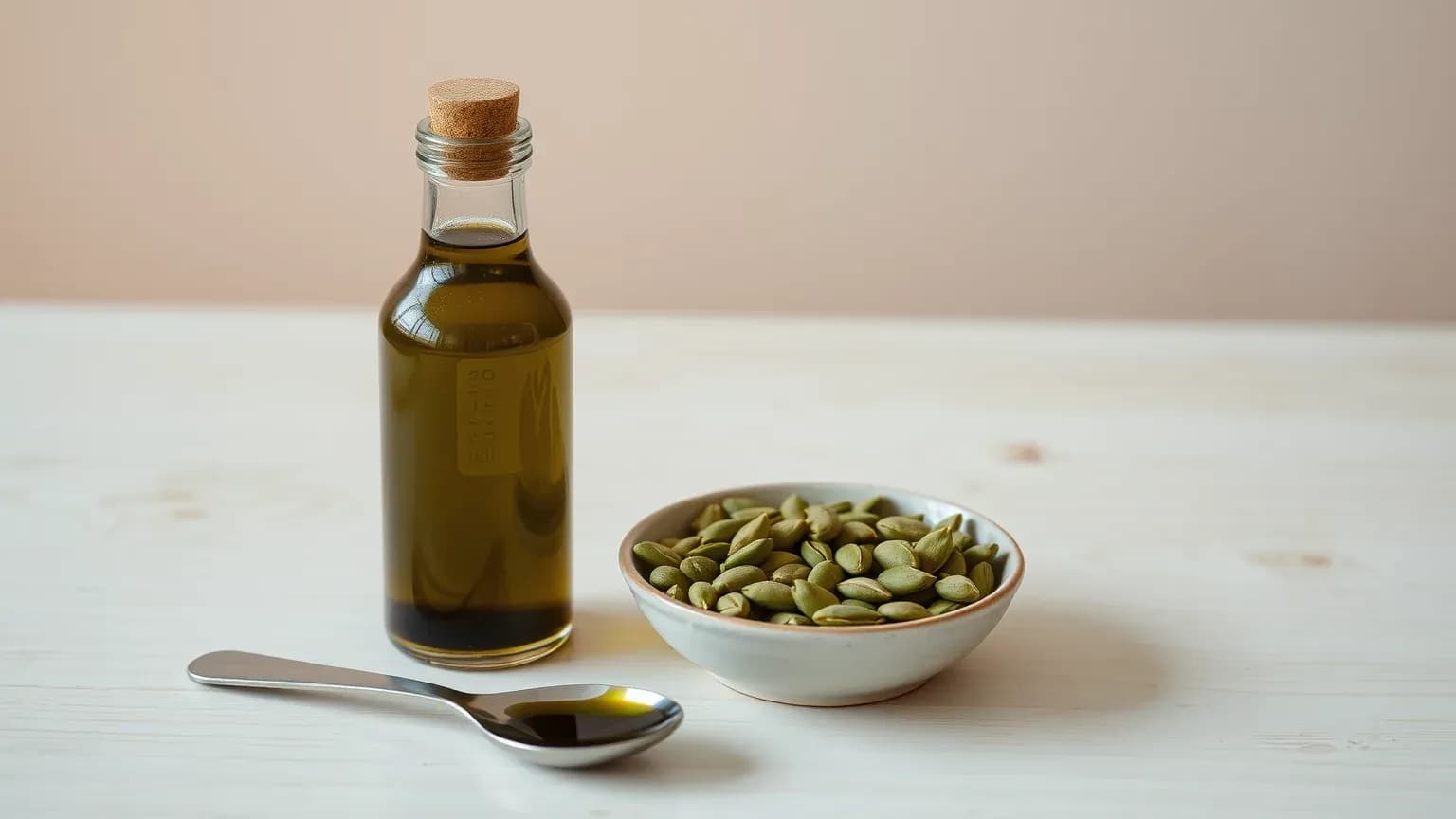
Pumpkin seed oil is one of the most recommended natural remedies for an overactive bladder, the condition where the bladder signals an urgent need to go at volumes it should comfortably hold. It is recommended to women and men alike, and supplement shops sell capsules for it. The evidence behind it is thinner than that suggests, and the one study of plain pumpkin seed oil used a dose almost nobody takes.
The dose question first
The only published study of pumpkin seed oil on its own for overactive bladder gave 45 people 10 grams of oil a day for 12 weeks. That is roughly two teaspoons of oil, or about ten of the standard 1,000 mg softgels sold for the purpose. Most people taking pumpkin seed oil capsules for their bladder take one to three a day, so a tenth to a third of the studied amount.
If you want to try pumpkin seed oil for an overactive bladder, that is the number to know: 10 g a day is the only dose with any data. Ten grams of oil is about 90 calories, which is worth knowing if you are watching weight, and taking it with food reduces the chance of an upset stomach.
What that study found, and its limits
After 6 and 12 weeks, scores on the Overactive Bladder Symptom Score fell significantly. The study used oil from Cucurbita maxima, a different pumpkin species from the Cucurbita pepo in most supplements, though the authors argued both work similarly.
The limit is large. There was no control group, so every participant knew they were taking a remedy. In overactive bladder that matters a great deal: placebo groups in bladder trials routinely improve substantially, because symptoms fluctuate, people start treatment when they are at their worst, and simply keeping track of drinking and voiding changes behaviour. An uncontrolled improvement cannot be separated from that.
What the blends showed
Most other studies tested products that combine pumpkin seed with other ingredients, which makes it impossible to credit the pumpkin seed for any effect.
A placebo-controlled trial in 81 women with urge, stress or mixed incontinence tested a combination of flower pollen extract, pumpkin seed extract and vitamin E for 90 days. Incontinence questionnaire scores improved significantly more than on placebo. That is the strongest result in this area, and it is for a combination in which pollen extract is the first-named ingredient.
A 12-week observational study of 117 women with overactive bladder took a combination of pumpkin seed oil, fragrant sumach bark and hops. Day and night voiding fell and leakage episodes fell by more than half. There was no control group, and the study was funded and partly run by the company that sells the product.
A randomised study in 90 women compared a blend of vitamins, Cucurbita maxima, capsicum and other ingredients with solifenacin, a standard overactive bladder drug, and reported the blend did better. It had no placebo arm, and the authors themselves said the numbers were too small for definitive conclusions.
What about water-soluble pumpkin seed extract?
Some products use an oil-free, water-and-alcohol extract of pumpkin seed rather than the oil, marketed for bladder control. The study usually cited for it was in 60 men with prostate enlargement rather than overactive bladder. Symptom scores fell 30 percent over 12 weeks and night-time urination decreased, but there was no control group and several authors were employees of supplement companies. There is no placebo-controlled trial of it for overactive bladder.
The honest summary
Pumpkin seed oil may help an overactive bladder. The single study of the oil on its own is uncontrolled, and it used a dose far above what most capsule users take. The best controlled result comes from a combination product led by pollen extract. Nothing here is strong enough to recommend pumpkin seed oil over the treatments that have been properly tested, and nothing suggests it is harmful to try alongside them.
What to try first
Bladder training: gradually stretching the time between voids during the day, starting with whatever interval you manage now and adding 15 minutes at a time over weeks. It costs nothing and is a standard first-line treatment.
Caffeine and fizzy drinks: both irritate the bladder. Cutting them for two weeks is a quick test of how much they contribute.
Fluid timing rather than fluid cutting: drink normally through the day and less in the two to three hours before bed. Drinking too little concentrates the urine, which irritates the bladder further.
Pelvic floor exercises: they help urgency as well as stress leakage, and a physiotherapist can make sure they are done correctly.
If those are not enough, the prescription options, mirabegron or vibegron and the antimuscarinic drugs, have been tested against placebo. Antimuscarinics are increasingly avoided in older people because of effects on memory.
If you try pumpkin seed oil
Use the studied dose, 10 g a day, rather than a single capsule. A bottle of culinary pumpkin seed oil and a measuring spoon is cheaper than ten softgels a day, and the oil can be taken in salad dressing or stirred into food rather than heated, which damages its flavour. Keep a three-day bladder diary before you start and again at 12 weeks: number of voids by day and night, and urgent episodes. Stop if the numbers have not changed.
When to see a doctor
Urgency that comes on suddenly, blood in the urine, pain or burning, fever, or difficulty emptying all need checking before treating it as an overactive bladder. In men, urgency can also come from an enlarged prostate, where the evaluation and treatment are different.
Frequently asked questions
- What dose of pumpkin seed oil for overactive bladder?
- The only study of pumpkin seed oil alone for overactive bladder used 10 g of oil a day for 12 weeks, about two teaspoons or roughly ten 1,000 mg softgels. Lower doses, which is what most capsule users take, have not been studied for this.
- Does pumpkin seed oil work for overactive bladder?
- Possibly, but the evidence is weak. The one study of the oil alone had 45 participants and no control group. The best controlled result, in 81 women, was for a combination of pollen extract, pumpkin seed extract and vitamin E.
- How long does pumpkin seed oil take to work for the bladder?
- The study measured changes at 6 and 12 weeks. Give it 12 weeks at the studied dose with a bladder diary before and after, and stop if nothing has changed.
- Is pumpkin seed oil or pumpkin seed extract better for overactive bladder?
- Neither has a placebo-controlled trial on its own for overactive bladder. The oil has one uncontrolled study at 10 g a day. The oil-free extract has been studied mainly in men with prostate enlargement, also without a control group.
- Does pumpkin seed oil help women with bladder leakage?
- A placebo-controlled trial of a combination containing pumpkin seed extract, pollen extract and vitamin E improved incontinence scores in 81 women. Whether the pumpkin seed contributed is unknown, since it was not tested alone.
- Are there side effects of pumpkin seed oil?
- It is very well tolerated. Large doses can cause mild digestive upset, and 10 g of oil adds about 90 calories a day.
Where to buy these
Single-ingredient products, so you can see the dose on the label. These are the ones we would buy; we have not tested them.
- Pumpkin seed oilCheck on Amazon
NOW Pumpkin Seed Oil 1,000 mg, cold pressed, 200 softgels
As an Amazon Associate we earn from qualifying purchases, at no extra cost to you. Buy from the brand or an authorised seller; forum users report counterfeit supplements from third-party sellers.
Related reading
Sources
- Nishimura M et al. Pumpkin seed oil extracted from Cucurbita maxima improves urinary disorder in human overactive bladder. J Tradit Complement Med 2014 (45 participants, 10 g oil a day, 12 weeks, no control group)
- Palacios S et al. Evaluation of Femaxeen for control of urinary incontinence in women: a randomized, double-blind, placebo-controlled study. Maturitas 2020 (81 women; pollen extract, pumpkin seed extract and vitamin E)
- Gauruder-Burmester A et al. Cucurbita pepo-Rhus aromatica-Humulus lupulus combination reduces overactive bladder symptoms in women: a noninterventional study. Planta Med 2019 (117 women, manufacturer-funded)
- Vecchioli-Scaldazza C et al. A randomized, multicenter, controlled study comparing efficacy and safety of a new complementary and alternative medicine versus solifenacin succinate in women with overactive bladder syndrome. Arch Ital Urol Androl 2017 (90 women)
- Leibbrand M et al. Effects of an oil-free hydroethanolic pumpkin seed extract on symptom frequency and severity in men with benign prostatic hyperplasia: a pilot study in humans. J Med Food 2019 (60 men, single arm)
This article is for information only and is not medical advice. Statements about supplements have not been evaluated by the FDA. Do not start, stop or combine supplements with prescription medication without talking to your doctor or pharmacist. If you cannot pass urine, or have chest pain, confusion or fainting, seek emergency care.